


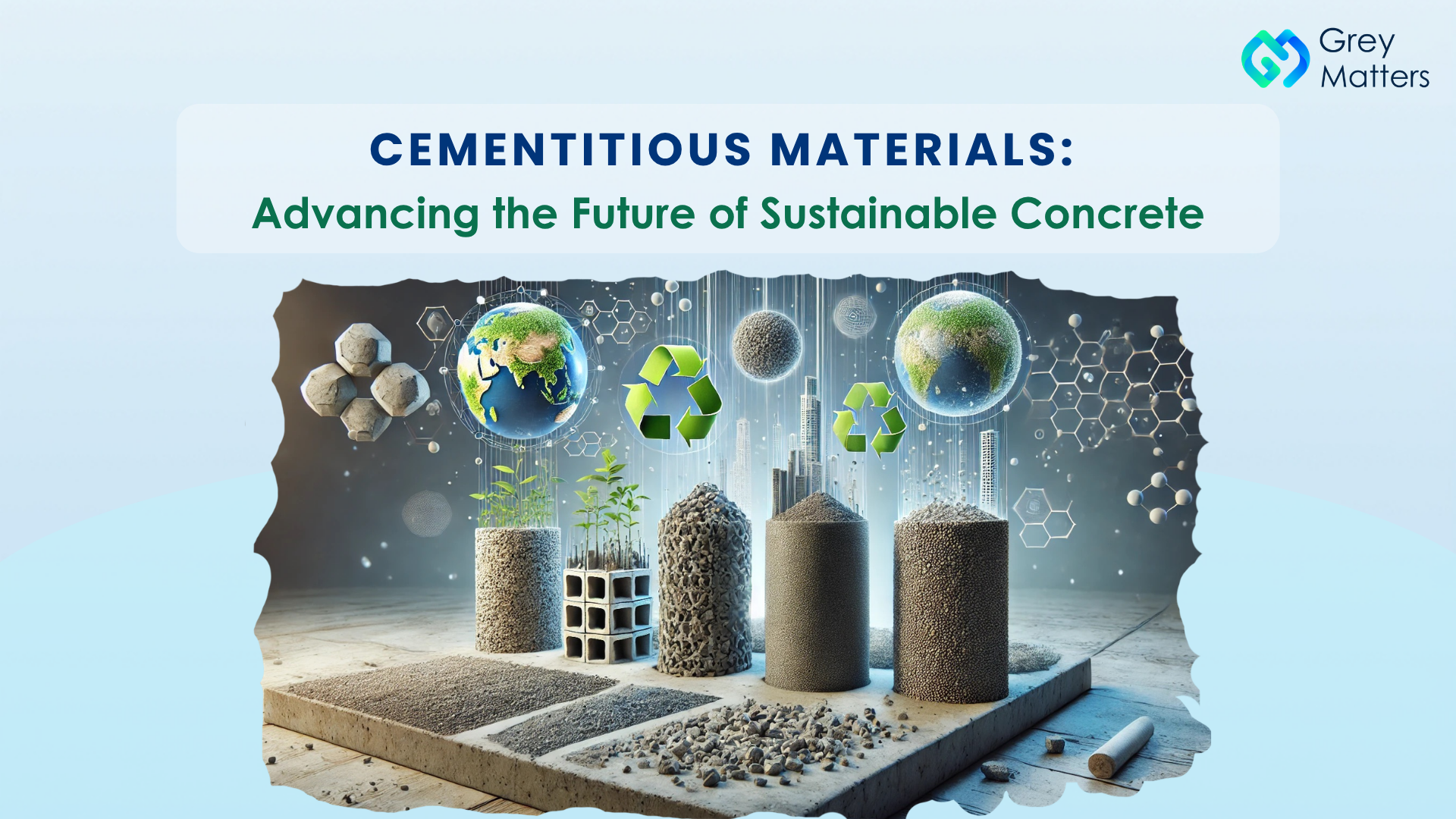
Cementitious Materials: Advancing the Future of Sustainable Concrete
Concrete remains the backbone of global infrastructure, yet its environmental footprint—driven largely by Portland cement production—continues to challenge the industry’s sustainability ambitions. As the world moves toward low‑carbon construction, cementitious materials have emerged as one of the most effective pathways to reduce embodied carbon while enhancing long‑term performance. Their role is not simply additive; they fundamentally reshape how concrete behaves, how long it lasts, and how responsibly it can be produced.
Cementitious materials, often referred to as supplementary cementitious materials (SCMs), are incorporated into concrete to partially replace Portland cement. This substitution is critical because cement manufacturing is energy‑intensive and releases significant CO₂ during clinker production. By integrating SCMs, the concrete industry can reduce its reliance on clinker, thereby lowering emissions without compromising structural integrity. In many cases, these materials improve the concrete’s durability, making structures more resilient and extending their service life—an essential principle of sustainable design.
One of the most widely used SCMs is fly ash, a fine powder generated from coal combustion. When added to concrete, fly ash enhances workability, reduces heat of hydration, and contributes to long‑term strength development. Its pozzolanic nature allows it to react with calcium hydroxide, forming additional calcium silicate hydrate (C‑S‑H), the compound responsible for concrete’s strength. From a sustainability perspective, fly ash represents a successful example of circular economy principles, transforming an industrial by‑product into a valuable construction material.
Ground Granulated Blast Furnace Slag (GGBS) offers another powerful route to sustainable concrete. Produced from the steel industry, GGBS significantly improves resistance to sulfates and chlorides, making it ideal for marine structures, foundations, and infrastructure exposed to aggressive environments. Its slow hydration rate also reduces thermal cracking in mass concrete applications. By replacing a substantial portion of cement with GGBS, concrete producers can achieve notable reductions in embodied carbon while delivering superior durability.
Microsilica, or silica fume, plays a different but equally important role. It’s extremely fine particles densify the concrete matrix, reducing permeability and enhancing resistance to chemical attack. This makes microsilica indispensable in high‑performance applications such as bridges, tunnels, and industrial floors. Although used in smaller proportions compared to fly ash or GGBS, its impact on durability is profound, contributing to longer‑lasting structures and reduced maintenance over the lifecycle of a building or infrastructure asset.
Emerging materials such as calcined clay and limestone powder are expanding the sustainability landscape even further. Calcined clay, especially when combined with limestone in LC³ (Limestone Calcined Clay Cement), offers a promising low‑carbon alternative capable of reducing clinker content significantly. Limestone powder improves particle packing and enhances early strength, allowing producers to optimize mix designs while lowering cement usage. These innovations reflect the industry’s shift toward more advanced, science‑driven approaches to sustainable construction.
The environmental benefits of cementitious materials extend beyond carbon reduction. By improving durability, SCMs reduce the frequency of repairs and rehabilitation, lowering emissions associated with maintenance activities. Their use also supports responsible resource management by diverting industrial by‑products from landfills and integrating them into high‑value applications. In sustainability certifications such as LEED v5, BREEAM, and DGNB, SCM‑enhanced concrete contributes to credits related to embodied carbon, material efficiency, and lifecycle performance.
In high‑impact sectors—such as marine works, high‑rise buildings, water infrastructure, and industrial facilities—the adoption of SCMs has become a defining feature of modern sustainable construction. These environments demand concrete that can withstand chemical exposure, temperature fluctuations, and long‑term loading. Cementitious materials provide the enhanced durability required to meet these challenges while aligning with global climate goals.
Ultimately, the use of cementitious materials represents a strategic shift toward smarter, more responsible concrete production. By reducing cement content, improving durability, and embracing circular economy principles, SCMs enable the construction industry to build stronger, longer‑lasting, and more sustainable structures. As environmental expectations continue to rise, cementitious materials will remain central to the transition toward low‑carbon, high‑performance concrete.


0 comments
Write a comment